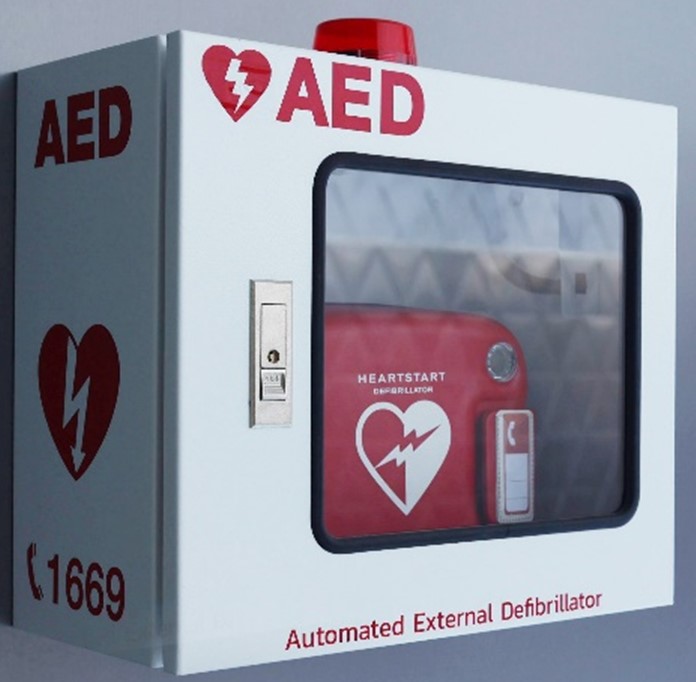
According to the National Heart, Lung, and Blood institute’s website, cardiac arrest causes about 300,000 to 450,000 deaths in the United States each year and has caused about half of the deaths linked with heart attack and stroke.[1] Sudden Cardiac Arrest (SCA) occurs when the heart is unable to work correctly and stops beating, which results in a person losing consciousness and not having a pulse. Performing cardiopulmonary resuscitation (CPR) in conjunction with a defibrillator can return an individual’s heart to a normal rhythm, thus saving the life of a person in cardiac arrest. Automated external defibrillators (AEDs) are one type of defibrillator that provide portability and ease of use for bystanders to quickly provide lifesaving care before the arrival of emergency medical services (EMS). The Sudden Cardiac Arrest Foundation states fewer than 5% of SCA victims are treated with an AED before the arrival of EMS. For every minute that passes without CPR and defibrillation, the chances of survival decrease by 7-10%.[2] Thus, early defibrillation from AEDs can improve survival rates.
Michigan State University strives to provide a safe and healthy environment for all faculty, staff, students, and visitors. To ensure the purchase, installation, operation, training, and maintenance of AEDs comply with university policy and best practices, the Department of Police and Public Safety (DPPS) has established this program in collaboration with MSU stakeholders listed in this document. This program is for all properties owned or operated by Michigan State University.
Locate AEDs across campus by accessing the AED Interactive Campus Map through the Campus Maps button in the SafeMSU app or by viewing the AED Interactive Campus Map online.
Please refer to the link below to download the
Automated External Defibrillator (AED) Program Guide
AED Request Form
Additional Resources can be located in the links below:
Inspection Link
Post Incident Link
Risk Management Injury/Property Damage Report Link
AED Policy